Local Search Rankings: What’s Actually Working Now?
Our friends over at WhiteSpark published a brilliant report on the latest local search ranking factors — and we’re here to give you a breakdown of what you should know.


SEO isn’t dead (by the way). You’d better believe there are plenty of experts willing to back me up on this.
What is dying? Consumers’ patience for endless scrolling through unconvincing local search results. Time is precious, attention is selective, and clarity matters more than ever.
That’s why local businesses can’t linger in hope below their competitors, whether that’s in organic search, Maps, or AI search tools.
For your potential customers, that could mean one scroll too many — one extra second — to find their answer or AI-generated recommendation. Businesses must make sure they’re found first, with maximum discoverability, minimal friction, top-of-mind presence.
Our friends over at WhiteSpark published a brilliant report on the latest local search ranking factors, and we’re here to give you a breakdown of the takeaways we found most interesting. There’s lots to unpack, so if you’re curious to learn more, we encourage you to read the entire report.
Should You Still Care About Rankings?
Short answer: yes.
Longer answer: yes, just not in the way you used to.
People still think of “ranking” as the exact order brands appear on the SERP. But in recent years, SERP positions have become less transparent and more volatile, thanks to shifting algorithms and AI search. The traditional idea (and goal) of ranking in positions 1 to 3 is less relevant, especially with the rise of the zero-click phenomenon.
But ranking — and the local search ranking factors behind them — do matter. Here’s why:
- You optimize for local search.
- You send a signal to platforms like Google or ChatGPT that your business is trustworthy, active, and ready for customers.
- Platforms are more likely to prioritize you in local search results and recommendations across multiple search experiences.
- You become more discoverable to potential customers and top-of-mind as they search for local businesses.
Consumer journeys have become messier, but all roads should lead to your business, so you don’t leave money on the table.
That’s why our team continuously urges every multi-location business we work with to prioritize initiatives that maximize their visibility within the Location Performance Optimization (LPO) framework.
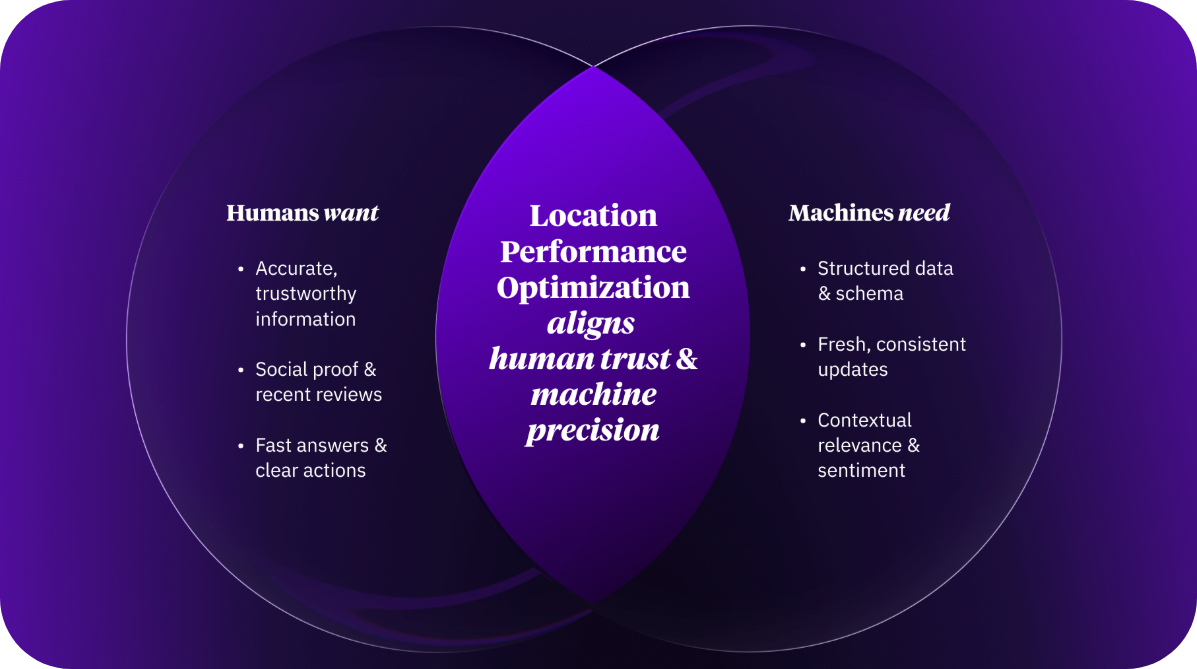
Businesses that invest in continuously strengthening these signals, and those highlighted in the WhiteSpark report, across every location, will consistently outperform their competitors in every local search experience.
Review Signals Matter in Every Search Experience
Saying review signals matter is a wild understatement.
They dictate discovery across Google Local Pack, organic search, and AI discovery results. Whitespark even found that they are the top ranking factor for local search advertising as well.
Put simply, review signals help search engines and AI models understand the quality of experience your business delivers — and whether you’re trustworthy, relevant, and worth recommending. According to the report, the following local search ranking factors carry the most weight:
- High numerical Google ratings (4–5)
- Quantity of Google Business Profile (GBP) reviews, with text
- Recency of reviews
- Sustained influx of reviews over time
- Keywords in Google Business Profile reviews
- Quantity of Google Business Profile reviews, without text
- Positive sentiment in review text
- Quantity of reviews with photos
- Keywords in third-party reviews
- Quantity of reviews with answers to review questions
- Quantity of third-party unstructured reviews (blogs, newspapers, magazines)
- Quantity of reactions to reviews
- Keywords in owner responses to reviews
- Quantity of reviews on industry-specific sites
- Quantity of third-party traditional reviews (Yelp, TripAdvisor, Yellow Pages, etc.)
- High numerical ratings by authority reviewers (Yelp Elite, Google Local Guides, etc.)
- Quantity of reviews with videos
- Presence of owner responses to most reviews
Volume, freshness, sentiment, and context all matter, and they matter everywhere customers search.
Encourage Customers to Leave Detailed Reviews
To make these ranking factors more actionable, this is what I’d suggest: Get your customers to leave you reviews by giving them QR codes, email reminders, and asking them in person. If you don’t ask, you don’t get, and if a customer is happy with their service, they’ll typically be happy to leave a review. It might feel like a chore in that moment, but in the long run see it as a growth opportunity.
It’s important, if you can, to remind customers to leave as much context in their review as possible. If they use relevant keywords to your business, even better. If they can attach photos or videos, even better!
If you find a way to scale this and take it beyond Google Business Profile, you’re onto a winner, because recency of reviews and the sustained influx of reviews over time are also local ranking factors – as is the quantity of reviews on industry-specific sites and on Yelp, TripAdvisor, etc. and from authority reviewers, such as Google Local Guides.
WhiteSpark’s Darren Shaw recommends: “Get reviews on the prominent review sites in your industry. You can't just send review requests to Google anymore. Make sure you have a testimonials/reviews page on your own site, and it's linked in the main nav.”
Respond to Every Review, Always
Part of your customer review management strategy should always be to respond to reviews.
You might think that negative reviews are the worst thing for your business, but they’re actually not. Not responding to them is worse — of course from a ranking perspective but even more so from a human perspective. Showing that you care about your service is good for business.
So, if customers are asking questions in their reviews, answer them. Be present. Be consistent. Be authentic. Use keywords, if they’re relevant.
Even if you nail some of these and weave them into your strategy – or you automate your review management better, you’ll be more visible across AI search, local pack, organic search, and consumers are more likely to find and choose your location over others based on trust and visibility.
Something’s Watching How You and Your Consumers Behave
As Darren puts it: “Real humans engaging with your GBP — by dwelling on it, looking through your photos, reading reviews, watching videos, and reading your posts — will definitely help you improve your rankings.”
When people interact with your content, Google reads those actions as strong signals of relevance and quality.
Here are some more components from the report to optimize in the coming year:
- Click-through rate from Local Pack/Maps search results
- Click-through rate from organic search results
- Volume of searches for business name
- Quantity of engagement signals on GBP (scrolling through listing, clicking on sections, reacting to reviews, etc)
- Quantity of engagement signals on website (scrolling pages, clicking on things)
- In-store visits tracked by Android or Google Maps Mobile app location detection
- Quantity of requests for driving directions from GBP
- Quantity of user-uploaded photos
- Length of dwell time on GBP
- Frequency of owner/manager activity
- Length of dwell time on GBP landing page
- Quantity of bookings through Google booking partners
- Number of bookings through GBP booking feature
- Quantity of reactions to photos/videos
- In-store visits tracked by third-party beacon or location detection technology
- Quantity of transactions identified through credit card partners
- Quantity of clicks to call business from GBP
- Sum of transactions identified through credit card partners
Build Out Your Business Profiles
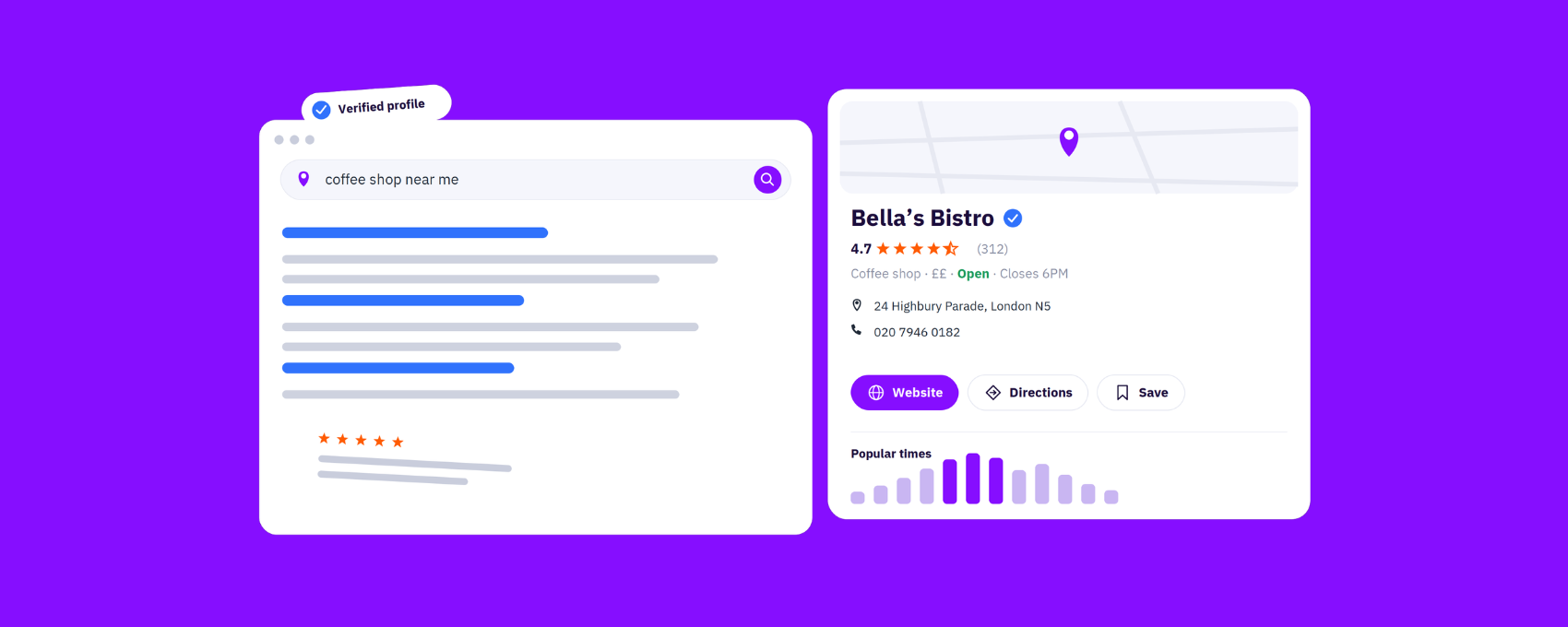
Build out your profile, update it regularly, and give customers something worth exploring. The more attributes, photos, Google Posts, you add, the more consumers will spend looking through your profile. They can’t spend time looking at what’s not there.
Make it as easy as possible for them to take action from your profile – calling, getting directions, booking appointments.
Not only will the algorithm reward this engagement with better visibility, but you’ll also inspire more real-world conversions — which is ultimately the win that matters most.
Build Out Your Brand’s Authority
Behavioral signals are becoming increasingly important, and they tie directly to the engagement pillar of LPO.
So make your content worth engaging with. Show your expertise, highlight your customers’ experiences through highlighting testimonials on your web content and profile content. Build your brand through being authentic and demonstrating E-E-A-T signals. Get customers familiar with your brand name so they search for you directly. And encourage user-generated content.
Social Signals Are Subtle But Becoming Stronger
This one is so important and increasingly fascinating for teams at the moment.
Not only are we hearing more about search becoming more visual through video and photos – with Instagram, YouTube, and TikTok videos ranking more prominently on search — Google Search Console now reports on social features. We’re following this one closely!
Here are the local search ranking factors to optimize for in 2026, according to WhiteSpark:
- Social profiles are linked to GBP
- Quantity of clicks on WhatsApp/SMS
- Presence of social media updates on GBP
- Frequency of Google Posts/updates
- Quantity of social media users mentioning the business
- Keywords in Google Posts/updates
- Recency of posts on social profiles
- Engagement on social profiles
- Quality of posts on social profiles
- Frequency of posts on social profiles
- Quantity of posts on social profiles
- Follower count on social profiles
- Quantity of clicks on WhatsApp/SMS
- Quantity of Google Posts/updates
- Whatsapp/SMS is enabled – not a strong ranking factor but helps increase conversions
Create Meaningful Posts
I would love to say it’s enough to be active on socials, but if you’re not engaging or connecting with potential and existing customers, your social strategy will fall flat.
You don’t need to chase viral videos. Post testimonials, user-generated content, answers to FAQs. Content that’s specifically relevant to your location or brand.
This type of content is unique, and it‘s far more effective than broad posts that attract hundreds of likes or impressions from people who likely have no intention of visiting you or buying from you.
Scale and Connect Your Social Efforts
Link your social profiles on your Google Business Profile, but don’t stop there.
Post where your customers are. Apple Showcases and Google Posts are underrated ways to scale your reach and engagement. You can repurpose the same images and copy you’ve posted on Instagram, for example, but with a different audience in mind.
The best social media management tools help you scale this so you can post across platforms with minimal manual effort. That way, you can just focus on connecting and delivering your key message to local audiences.
New Ranking Factors to Consider
I understand I’ve left you with lots to digest at this point, but I want to leave you with food for thought for the coming months ahead.
The report also pointed out these new local search ranking factors:
- Business open at time of search
- CTR from Local Pack/Maps
- Keywords in GBP custom service titles
- Quantity of reviews with photos
- Photo and video quality (resolution, clarity, not stock, etc)
- GBP popular times section shows business as busy
- Freshness of content on GBP landing page
- Quantity of reviews with videos
- Scannable content structure across entire website (headings, bullet points, images, etc)
I’m not sharing these to make you feel like you need to reinvent the wheel. Instead, they should validate what you’re already doing: keeping listings accurate, ensuring reviews have context, maintaining high-quality images and videos, keeping content fresh, and following basic on-page SEO best practices.
These factors are critical within the LPO framework and will help boost your brand’s visibility, reputation, engagement, and conversions.
Equipped for Another Year of Local Search Optimization
Google still provides the best experience for local-intent queries — for now, better than LLMs like ChatGPT, AI Mode, or Perplexity. But it’s smart to stay a step ahead, ranking and appearing wherever consumers are searching in the year ahead.
It’s not about reinventing the wheel. While the outputs of local search are evolving — the interfaces customers use to discover businesses — the input hasn’t changed dramatically.
If you’ve already been investing in solid GBP optimization, high-quality content, and a trustworthy reputation, following the LPO pillars, you shouldn’t need to change anything about what you’re doing.
The next step is to double down and scale these efforts across all your locations. Get those signals signalling more than ever, and build even more confidence in your customers.


1,800 brands trust us to stay visible
— not just show up once or twice in local search.



.png)
