How Do You Report on GEO Metrics When AI Models Agree on Less Than 6% of Local Business Recommendations?
A practical GEO analytics guide to the AI search metrics multi-location brands need to track, how to interpret your GEO dashboard, and what the numbers can't tell you yet.

Key takeaways
- GEO metrics measure three dimensions — visibility, competition, and trust — and they only become meaningful when you read all three together over weeks
- A badly built prompt set will skew your AI visibility data when you report to your leaders
- Know what the numbers can't tell you before someone asks because the person reading your report will eventually ask

A US restaurant brand — one of our clients — with hundreds of locations standardized its location names, cleaned up listings, added structured menu data and detailed attributes across review and directory sites.
The team increased the brand’s AI citation rate tenfold and more than doubled its mentions for unbranded prompts. But, of course, they weren’t only tracking “best restaurant” prompt variations. They were savvy enough to measure their AI visibility across multiple intent types — from “best” and “highly rated” to “affordable,” “family-friendly,” and attribute-specific searches like “outdoor seating near me.”
In our own monitoring framework research by our GEO/AEO Analyst Katya Shishchenko, tracking just 7 intent types captured less than half the businesses AI models actually recommended. It took 11 to reach 80%.
And even a well-built prompt set only shows you one part of the problem. In Katya’s cross-model consensus study (which we’ll discuss more below), when the same prompts were run across all AI models tested over multiple runs, less than 6% of the businesses recommended appeared consistently across models. For restaurants, only 2.3% appeared consistently. We’re talking about the same question, asked to different AI tools, which produces recommendations that barely overlap.
Metrics for AI visibility exist, and so do the GEO dashboards. But variables like prompt intent and AI models critically shape every brand’s understanding of their actual visibility right now. They’re looking at the right metrics, but not necessarily drawing the right conclusions.
They can only do that when they optimize for maximum model coverage and intent coverage from the get-go — and report on that. That will deliver the GEO reports that will hold up in the face of some light interrogation from your CMO about your brand’s discoverability in AI search.
3 Dimensions of AI Visibility; 3 Questions to Ask Your Tool
Before we start introducing the key AI search metrics everyone has been talking about this year, understand how you can break AI visibility down into three dimensions — the first two of which ultimately overlap with what we have been tracking in traditional local SEO:
- Visibility: Am I showing up in AI answers? Across which prompts and intent types?
- Competition: Who appears alongside me, and who “replaces” me? Out of every AI answer that names a brand in my space, how many name mine?
- Trust: Am I credible enough to be cited?
These three dimensions tell you different things about the same prompt set. Alone, your visibility metric (mention rate) might show that you feature in AI recommendations. Your competition metric (share of voice) says you’re featuring among a lot of other businesses. Your trust metric (citation rate) tells two stories: are you reputable enough that AI links to you as a source? And when you’re not being cited — or not being mentioned at all — which sources is the model drawing from for your vertical and your competitors? Monitoring those cited sources tells you where you need to be present with complete and accurate information, not just whether you’re being linked to.
So, our advice is, when you’re looking at your GEO report, ask yourself the following questions:
- Am I visible at all?
- Am I winning versus competitors?
- Am I trusted and influential?
The right AI search metrics with healthy respect for the variables we spoke about above — intent coverage and AI model coverage — will help you answer truthfully.
Am I Visible at All?
Let’s start with Absolute Mention Rate and Impressions Captured.
A mention is any neutral reference to your brand in an AI-generated answer. It signals visibility but doesn’t indicate that a tool — be it Claude or Gemini or ChatGPT — is recommending you. It’s almost like how we think of organic SEO impressions in Google, in that you know you appeared in search results, but you may have been way, way, way down the SERP.
Your Absolute Mention Rate (AMR) measures how often your brand appears in relevant searches across all AI responses, regardless of competitor mentions. Think of it as: Out of everything the AI said, how often did I show up?
Impressions Captured estimates how many people could see content from your website or domain when it appears in an AI answer. If your Boston coffee shop is cited in an answer reaching 10,000 users, that’s 10,000 impressions captured. Tracking this helps you see which websites or domains put your brand in front of the most potential customers.
But “visible” really depends on where you look. If we go back to Katya’s cross-model consensus study, only 5.5% of businesses recommended for any given prompt appeared across all AI models tested. Nearly 2 in 3 appeared in one model’s recommendations only — invisible to the other four. This inconsistency varies by business category: Banks reached 10% consensus, restaurants 2.3%, dental effectively zero.
That’s because each model builds its recommendations from different signals, different sources, and different weights — and that’s why GEO Studio tracks brand visibility and GEO Pulse local visibility across 9 AI models separately rather than blending them into a single score.
Together, AMR and Impressions Captured give you your visibility numbers — but only when you’re monitoring them across models. They show you whether your brand is present, discoverable, and reaching real audiences at the earliest moment of AI discovery.
Am I Winning Versus Competitors?
The real question a lot of brands are coming to us with now is “How does my brand perform compared to local competitors in AI-generated answers?”
That’s when you look at Relative Mention Rate, Share of Voice, and Mention Gap.
Relative Mention Rate (RMR) shows how often your brand appears when brands are mentioned at all, compared to competitors in the same set of AI answers. GEO Studio calculates this by excluding responses with no brand mentions, making RMR a good indicator of competitive strength: When the AI names names, how often is it naming you versus everyone else?
Share of Voice (SoV) shows how frequently your brand appears in AI-generated answers within a specific category or prompt set. AI SoV is earned through strong coverage, credibility, and high-quality content. But you can only measure it effectively when you track diverse intent types.
But your competitive position isn’t stable across models. In our cross-model research this year, each AI platform showed a distinct “personality” when recommending businesses — for the same prompt.
- OpenAI (ChatGPT) picks favorites and sticks with them. If it recommends your business once, it’s likely to recommend you again and again — but its shortlist is small, meaning most businesses in your category never appear at all.
- Gemini casts the widest net, surfacing more businesses than any other model thanks to its connection to Google Maps and Google Business Profile data. It also cited branded websites as sources at a higher rate than Perplexity — so if your brand’s local pages are well-structured and indexed, Gemini is the model most likely to link to them.
- Perplexity is the most balanced — it doesn’t concentrate mentions on a few winners the way ChatGPT and Gemini do. It’s also the only model that retrieves live from the web rather than relying on training data, which means it cites the most diverse range of sources — editorial guides, review platforms, directories — and its results can differ significantly from what the other models surface. But it covers the smallest pool of businesses overall, so if you’re not in its pool, that even distribution and source diversity won’t help you.
- Claude surfaces the broadest universe of businesses of any model we tested, but the vast majority of those appeared only in Claude’s answers and nowhere else. It sees the most, but shares the least with other models.
- Grok doesn’t concentrate citations as heavily as ChatGPT, doesn’t cover as many businesses as Gemini, and draws on a different mix of signals — pulling more from social content and less from traditional web pages.
A brand can dominate in ChatGPT’s answers and barely register in Perplexity’s. And if Claude recommends your business, you’re probably not appearing in the other tools.
Even within a single model, most businesses get mentioned once or twice while a few dominate the AI-generated recommendations. Our cross-model study showed us this was the case for any given prompt — especially for restaurants, where the gap between the top-mentioned brands and everyone else was the widest.
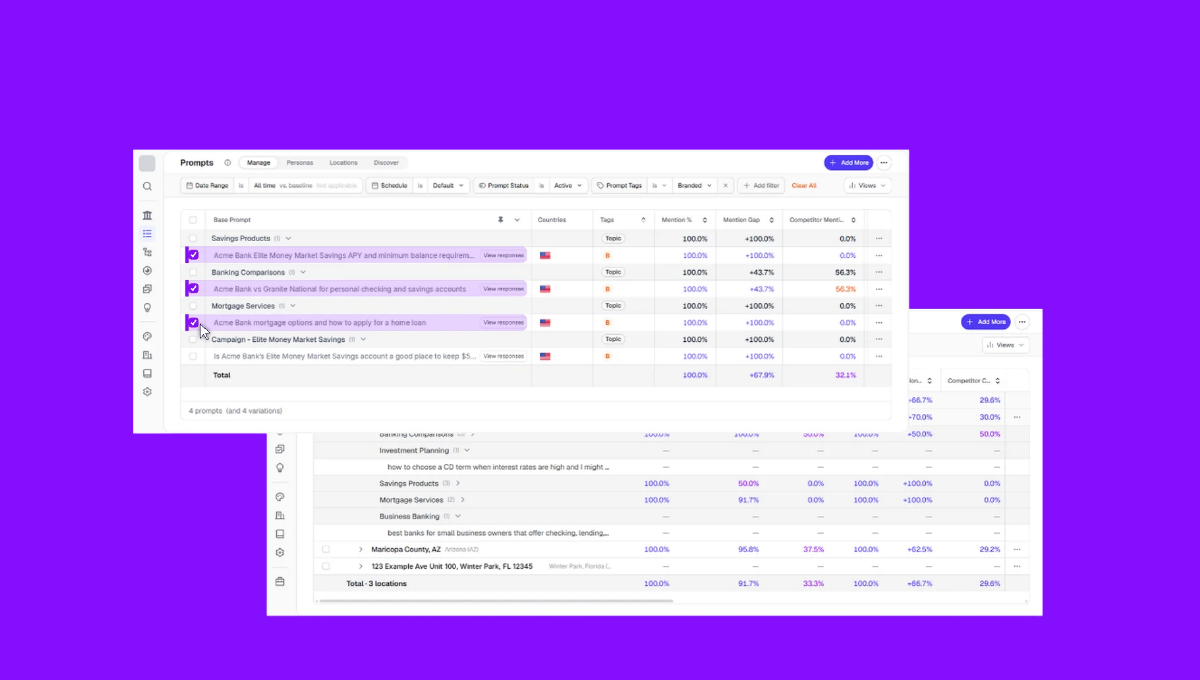
Your Mention Gap is the difference between your Mention Rate and your competitors’. GEO Studio shows you’re outperforming the field when there’s green in your prompt set. Red signals missed content, coverage, and authority opportunities where competitors show up more often than you do in AI results.
Am I Trusted and Influential?
A citation is a reference to your business in an AI-generated answer that directs users to a web page. When a consumer asks ChatGPT for a coffee shop in Boston and gets directed to your local page, that counts as a citation.
Citation Rate shows the percentage of times your brand is cited compared to all other brands for the prompts you’re monitoring. A higher, more consistent rate signals stronger authority and influence.
Your Citation Gap measures the difference between your Citation Rate and the top-performing competitor across the same prompts. Closing this gap means your business location gets referenced more frequently, which strengthens credibility at the moment customers make decisions — tying directly to your Location Performance Optimization.
Citation isn’t evenly distributed either. In our Directory Presence and AI Citation Sources study across 47,920 AI responses and 617,201 parsed citations, 46.9% of all sources AI models cited came from directory-equivalent platforms — business directories, review sites, local guides, social media, booking platforms, specialty aggregators, and navigation apps.
Brand-owned domains accounted for 35.5% — the second-largest category — meaning your own website is already a significant citation source. But that still leaves nearly two thirds of citations pointing to third-party sources: editorial guides like Timeout and Michelin, review platforms like TripAdvisor and Yelp, and local city guides. If you’re not showing up on the platforms AI draws from beyond your domain, closing your citation gap usually means looking at location data consistency and third-party presence alongside your own website content.
Source attribution shows you where those citations come from — your owned content, local pages, blogs, or third-party sites like TripAdvisor, Yelp, or Google Business Profile. Your brand’s own pages are important for visibility, but diversify where you talk about your locations — AI models pull from multiple sources before deciding who to cite, and a brand that shows up consistently across them is harder to drop from that AI response.
GEO Metrics Summarized: The Random Coffee Shop Example
Say you’re tracking a specialty vegan coffee shop called Oat Habits Die Hard in South End, Boston.
You’re not just tracking one prompt — you’ve built a set that covers multiple intent types: “Best coffee shops for working in Boston,” “affordable coffee near South End,” “vegan-friendly cafés with outdoor seating Boston,” “where do locals go for coffee in South End,” and “Oat Habits Die Hard vs. Starbucks.”
You’re also letting GEO Studio run across 9 models — including ChatGPT, Claude, Gemini, Perplexity, Grok, DeepSeek.
Here’s how each GEO metric reads across that set.
* For the given prompt set and AI model coverage chosen in GEO Studio, GEO Pulse or other AI tools.
What Your GEO Metrics Can’t Tell You
There’s a disclaimer (or 4) that should come with every AI visibility tool. Share these with your team because, from our experience, they’ll probably come up as questions eventually.
- A mention rate is not a conversion rate. Being named in an AI answer doesn’t mean someone visited your location, called your number, or bought anything. The mention happened inside a model’s response — you don’t know whether the person read it, trusted it, or acted on it. AI discoverability has simply made attribution and the customer journey more complex.
- A single-run snapshot is an anecdote, not an actionable item. AI outputs vary by session and platform — the same prompt asked twice in the same hour can produce different business recommendations. Your metrics only become meaningful over repeated runs and weeks of data.
- A mention only counts if the AI used a name you’ve registered. AI models refer to brands inconsistently: with and without a suffix, in lowercase, by domain, by nickname. GEO Studio counts a mention when the answer contains one of the identifiers stored for your brand.
- A business’s position in an AI answer is the order of one run, not a ranking. A Google position often persists between checks. That’s not the case for AI tools. Report your average AI model position over several runs — and if you’re reporting a mention loss, open the Responses view first: A new competitor in the answer is good intel; the same brands in a different order isn’t.
Read Your GEO Analytics Without Overreacting
GEO produces its first measurable signal roughly 2 to 3 times faster than SEO — weeks, not months. That means you’ll be presenting your GEO report to leadership sooner than you think.
When you do, the two variables from the top of this article — intent coverage and model coverage — will determine whether your proposed strategy holds up or crumbles under the first question. That, and your honesty about what AI search metrics don’t tell you about your AI visibility.
That’s how your GEO reporting earns your team’s trust.


1,800 brands trust us to stay visible
— not just show up once or twice in local search.




Frequently Asked Questions
A GEO visibility report shows how your brand appears in AI-generated search responses — whether you’re mentioned, cited as a source, recommended over competitors, and perceived positively. Unlike traditional SEO reports that track rankings and clicks, a GEO visibility report answers four questions: Am I visible at all? Am I winning versus competitors? Am I trusted and influential? And what should I do next? GEO Studio is the first tool built to deliver this reporting for multi-location brands.
Traditional SEO metrics (rankings, clicks, impressions) were designed for blue links. GEO metrics measure something different: whether your brand is included in AI-generated answers at all. In generative search, there’s no page one and no list of links. If your brand isn’t mentioned, cited, or recommended in the AI response, it’s invisible at the moment of decision. GEO metrics like Mention Rate, Citation Rate, and Share of Voice track that new layer of visibility.
Share of Voice (SoV) in AI search shows how frequently your brand appears in AI-generated answers within a specific category or prompt set compared to competitors. Unlike paid search SoV, AI Share of Voice is earned through strong content coverage, credibility, and authority, not media budgets. GEO Studio also measures your relative SoV across different AI models — ChatGPT, Gemini, Perplexity, Copilot, and Claude — so you can see where your brand shows up and where there are gaps.
Mention Rate measures how often your brand is referenced in AI-generated answers — any neutral mention counts, whether the AI names you in a list or describes your service. Citation Rate measures how often AI links to your content as a source. A mention means you’re visible; a citation indicates you’re trusted. A brand with a high Mention Rate but low Citation Rate is being talked about but not linked to, which means the AI may be pulling your information from third-party sources rather than your own content.
Prompt Volume estimates how often a specific question is being asked by consumers in AI search — similar to keyword search volume in traditional SEO. GEO Studio layers in Prompt Value (volume multiplied by a comparable keyword bid price) and Prompt Opportunity (trending prompts gaining traction over time). You prioritize by targeting prompts with the highest combination of volume, value, and growth — that’s where consumer intent is strongest and where AI visibility gains will move fastest.
GEO visibility reports improve local SEO strategies by revealing a layer of performance traditional reports miss entirely. If local businesses aren’t tracking their visibility in AI search, they’re blind to how more than 30% of consumers now discover them. A GEO report identifies which prompts drive customers to you versus competitors, which content gaps are limiting your AI visibility, and where small authority investments can close the Mention Gap or Citation Gap fastest, turning AI search from a black box into an actionable channel.