Holiday Hours, Address Variants, Duplicates: Stay in Sync With One Update Across Every Platform — Before You Confuse the Search Tools

Key takeaways
- Get your Google Business Profile right first — claimed, verified, and fully completed for every location — before spending time on any other directory
- Google reads “123 Main Street” and “123 Main St.” as two different addresses, so identical name, address, and phone formatting across every directory is what stops duplicate listings forming
- Updating citations by hand doesn’t scale — a single source of truth that pushes one change everywhere at once is what keeps hundreds of listings accurate
“If the formatting is a little bit off, then Google and some of the other crawlers treat these addresses as different. And then potentially they start creating duplicates for you.”

HQ changes the customer service number for every store. You need holiday hours live before next week’s long weekend.
Say you’re an enterprise business — a grocery or optician chain: If every location you need to update is listed on 30-odd directories, your urgent changes become thousands of separate manual edits. Ctrl C’ing and V’ing is fast, but it’s not that fast. It’s also not usually free from human error.
When your location data stops matching across the web, it shows up in your performance numbers, through Local Pack rank slips and visibility drops. That’s if you don’t hear about it from a customer first.
These inconsistencies (even if it’s just one single character) often also lead to duplicate citations and hurt your visibility. Our Principal Solution Engineer at Uberall, Ehab Aboud, explains:
{{quote}}
So how do you get all of that fixing and updating down to a single push from one source-of-truth platform — one that reaches the locations that need changing and keeps them that way when the next aggregator refresh or third-party edit comes through?

Audit Which Citations You Already Have
Your first move is simple: See which local citations are actually live. A lot of brands we work with rarely do this after they launch, but we all know (for better or worse) that listings updates keep us on our toes. Hours get edited, aggregators republish whatever they last had, and third parties suggest changes Google often accepts at face value.
One regional energy provider we work with in Europe expanded so quickly its listings never kept up: Locations went live faster than anyone could claim or manage the profiles, which left the data open for aggregators and third parties to fill in — often wrong. Its dashboard reported a 97% claiming rate the whole time, but nearly a third of its active locations existed only as unclaimed dummy listings — counted as managed, but with no ownership, no brand control, and no review management. An audit surfaced this.
Pull every location’s listings across your directories and identify what needs cleaning up. For example,
- Are there duplicates?
- Are there incomplete or outdated profiles?
- Are located-in listings accurate?
In summary: Is there anything that doesn’t match your source data? At scale, something is always breaking somewhere; the only question is how quickly can you catch the problem listing(s)?
The next thing I’d check is where you’re not listed, and this is worth reviewing semi-regularly, as AI models and customers chop and change where they seek information. It’s worth checking where your competitors are listed — and the information they share on their listings — and compare it against your own directory presence.
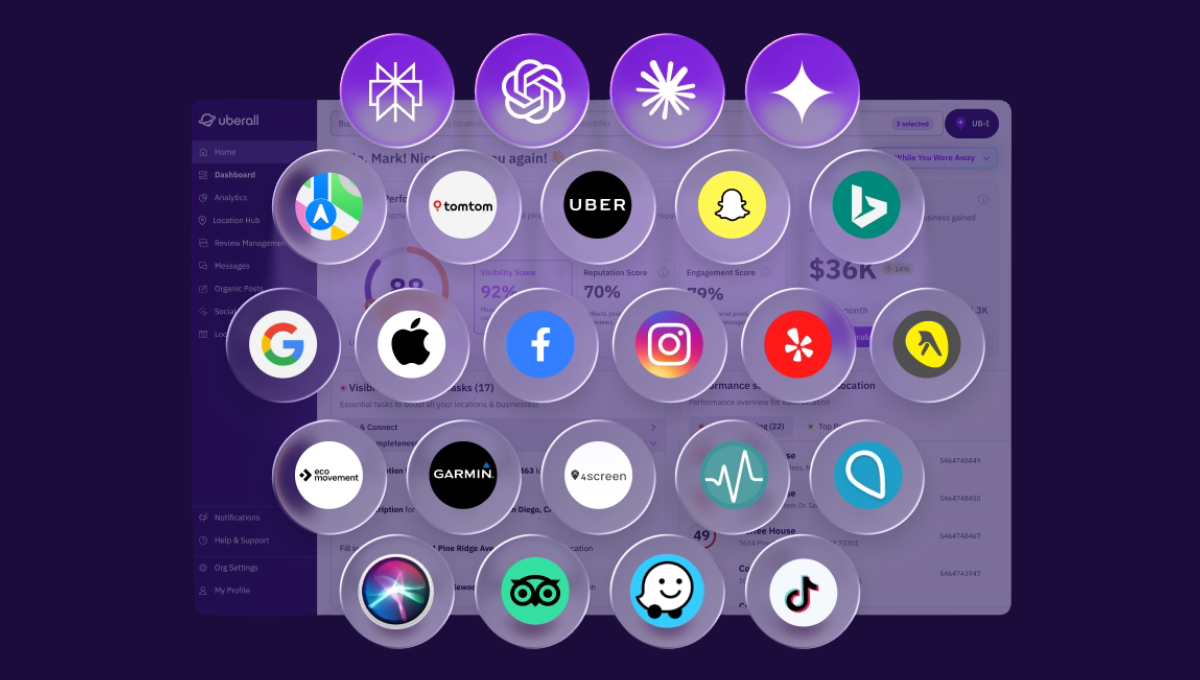
Uberall’s own research across 120,000+ AI mentions — five verticals, five AI models — found that AI systems lean on Google Business Profile (GBP) data, review platforms, and editorial coverage, while transactional platforms like Booking.com, Expedia, and Instacart added essentially nothing to whether a business got named.
Audit your footprint against the platforms AI models actually cite frequently — not the ones that just take payments.
Confidently Push Once, to Every Relevant Location and Directory
When you hold each location’s data in one place, in one ultimate document of truth, Uberall’s platform lets teams make the change once and push out to the connected directories that matter for that location, not a manual Ctrl-C-and V-spree through 30 tabs per store.
Our Location Data Management platform keeps that source data accurate in real time and overwrites unauthorized edits, so the aggregator refresh or third-party change that used to un-sync your hard work gets corrected instead of published.
Then there’s the monitoring part. I said earlier that something is always breaking somewhere — the real question is whether you or potential customers catch it. UB-I, our agentic AI for location performance, scans every location continuously, spots duplicates, half-finished or optimizable profiles, and fields that no longer match your source data. It ranks them by business impact and either queues or makes the fix — updated hours, a corrected category, a completed description — for you to approve.
And there you have it: The regular audit from the last section stops being a single person’s job and runs in the background instead.
Local Citation Management by Hand Versus At Scale
AI models are “hungry” for extra context about each business — but feeding them updated listings information is more than what a person or small team can’t do manually (or accurately, for that matter) across hundreds of locations.
And the bigger issue is what all those manual edits do. Every one is a chance for a typo, and a typo or address variant is all it takes: “123 Oak Street” and “123 Oak St.” might be the same place to you but two separate locations for Google and AI systems. If that happens across hundreds of locations, cleaning this up costs a lot more time and energy than the original change ever would have.
This is also why bulk changes to the sensitive fields are risky — and why that approval step in our UB-I Agent Control Center matters. Change a business name, address, or primary category across a lot of locations at once and you can trip Google’s re-verification checks, even on accounts that were already verified.
Do your local citation management at scale with a platform, though, and your team not only wins back time and energy to work on optimizations instead of fixes — but also AI visibility due to your clean listings data.
Our Uberall AI visibility research found that the two GBP fields teams skip most, photos and category or attribute completeness, are among the strongest predictors of whether AI models name a business at all. Completing a profile’s attributes lifted mention rates by 40 to 60 percentage points in some of the verticals it studied, and photo count was the single strongest predictor of how often a business got named — and consistently the most underinvested.
Everything’s in Sync, Without You Having to Overthink
Multi-location business visibility starts with the boring stuff.
The audit to see what’s live, to see where your opportunities are, to see where the fixes are hiding. It’s the work that influences your Local Pack ranking and AI mentions — and it’s the work we support and cheer enterprise teams on for.
The good news is that the boring stuff doesn’t have to stay a person’s job. The view from the other side — centralized citation management, one source of truth, monitoring that runs on its own — is pretty sweet.



1,800 brands trust us to stay visible
— not just show up once or twice in local search.






Frequently asked questions
Local citation management is the process of building, maintaining, and monitoring your business’s name, address, and phone number (NAP) across online directories, review sites, maps, and data aggregators. For multi-location brands, this means keeping every location’s data identical everywhere it appears — and catching the inconsistencies that form when aggregators refresh, third parties suggest edits, or teams update hours and phone numbers. Consistent local citations are now a prerequisite for both Local Pack rankings and AI recommendations.
You build local citations for multiple business locations by holding each location’s data in a single source of truth and pushing changes once to every connected directory — not by copy-pasting through 30 tabs per store. Start with an audit to see what’s live, fix duplicates and incomplete profiles, then use a location data management platform that overwrites unauthorized edits and keeps your data accurate in real time. Manual citation building doesn’t scale: Every edit is a chance for a typo, and a single typo multiplied across hundreds of locations creates a data quality problem that costs more to fix than the original change.
NAP consistency matters because search engines and AI models treat even minor formatting differences as separate locations. "123 Oak Street" and "123 Oak St." might be the same place to you, but Google and AI crawlers can create duplicate listings from that one-character difference. At scale, these duplicates hurt your visibility in both the Local Pack and AI-generated recommendations. Identical formatting of your name, address, and phone number across every directory is what stops duplicate listings from forming in the first place.
An enterprise citation audit should cover four things: Which listings are actually live and whether they match your source data, whether any duplicates exist across directories, whether incomplete or outdated profiles are still published, and where you’re not listed but should be. Check your located-in listings for accuracy too — stores inside malls or shopping centers often have a separate set of issues. Then compare your directory presence against competitors and against the platforms AI models actually cite, not just the ones that take payments.
The directories that matter most for AI visibility are Google Business Profile, review platforms like Yelp and Google Reviews, and editorial or industry-specific sources. Uberall’s research across 120,000+ AI mentions found that AI systems lean heavily on GBP data, review platforms, and editorial coverage when deciding whether to recommend a business. Transactional platforms like Booking.com, Expedia, and Instacart added essentially nothing to whether a business got named. Audit your footprint against the platforms AI actually cites — not the ones that just take payments.
The two GBP fields with the biggest impact on AI mentions are photos and category or attribute completeness — and they’re also the two fields teams skip most. Uberall’s AI visibility research found that completing a profile’s attributes lifted mention rates by 40 to 60 percentage points in some verticals, and photo count was the single strongest predictor of how often a business got named. These aren’t optional; they determine whether AI models consider your location at all.
Local citations still work for SEO — and they now matter for AI search too. AI models cross-reference your business information across directories, review sites, and structured data before deciding whether to recommend you. Inconsistent or missing citations reduce the AI’s confidence in your business, while a clean, consistent presence across the right platforms strengthens both your Local Pack ranking and your chances of being named in AI-generated answers. The work is less glamorous than content creation, but it’s the foundation everything else depends on.
How long citation building takes depends on whether you’re doing it manually or through a platform. Manually, a single location requires claiming and verifying profiles across 30+ directories, formatting NAP data identically in each, and fixing any duplicates you find along the way — that can take weeks per batch. With a location data management platform, the initial push to connected directories takes hours rather than weeks, and ongoing monitoring runs continuously in the background. The real time cost isn’t the initial build — it’s the ongoing maintenance that catches unauthorized edits and aggregator refreshes.