Get It Done, Stay in Control: How UB-I Executes Location Marketing Tasks in Seconds
Multi-location brands don’t need another dashboard. UB-I drafts review replies, corrects listings, and completes profiles across hundreds of locations — then queues everything for your team’s approval.

- UB-I is an AI agent that works in the background across one connected layer of location data — listings, reviews, social posts, and local pages
- UB-I drafts review replies, corrects listings, and completes profiles across hundreds of locations — then queues everything for human approval before it goes live
- The era that rewarded buying tools is over; the next one rewards putting one agent on a clean foundation and letting it execute tasks that teams used to do manually
“AI is quickly becoming more and more common in the workflows of many different professionals, but we know not everyone is ready to trust AI output without verification. It is important for us that Uberall users trust UB-I so that it can truly lift the weight of their shoulders, and transparency is key for that. That's why UB-I always highlights what changes were made, which are the affected locations, and asks for confirmation, this way users are always in control.”

The answer to every marketing problem has long been another tool, another agency — maybe even new hires. But when the solution needs to scale, it’s often martech demos that get booked into calendars, not hiring interviews or agency intros.
Need help managing reviews across multiple platforms? Buy this tool. Need to post local social content across hundreds of locations? Buy this tool. Need to ensure listings accuracy across 200 directories? Buy this tool.
One multi-location brand with over 500 locations came to us after cycling through two listing management platforms in three years. Their digital experience manager was manually updating bakery opening hours three to four times a week. Google was overwriting her location data faster than she could fix it. The previous platform’s auto-reject for unwanted Google edits didn’t work properly. After eight months of onboarding, they still hadn’t been able to switch on the review management module they’d signed up for.
Our G2 reviewers want the same thing we do: Instead of 200 listings flagged for manual fixing, they want them fixed.
We built and refined UB-I to do exactly that. It’s one intelligent agent on top of a clean, connected platform that acts on the issues or opportunities it finds, queues them for your approval, and resolves the to-do tickets rather than … well, just flagging them.
Which Tool Becomes the Most Adoptable and Scalable of Them All?
There are only so many “State of” reports a CMO can take in a year this disruptive. Have some mercy — inboxes are almost infringing on storage limits.
But there’s a lot to take from Scott Brinker’s State of Martech 2026, which tells us the martech technology market is consolidating, not growing, with the number of tools only up less than 1% from last year. And that’s because thousands of tools were removed from the market last year. It’s not a SaaSpocalypse but a survival of the fittest — the most scalable and adoptable tools in the market.
This survival story goes deeper than new tools and pretty upgrades – buckling on more functionalities in hope of better marketing results and stronger adoption. As Scott Brinker writes, it’s about a “structural transformation — of the technology, the practice, the roles, and the relationship between brands and customers.”
We take this transformation seriously with our location performance agent UB-I:
- UB-I is the technology: Our in-platform ambient agent that executes tasks across listings, reviews, social, and local pages.
- LPO is the practice: Location Performance Optimization ties location marketing actions to actual revenue impact — so every task UB-I prioritizes is ranked by what moves the business.
- The roles: The user becomes the approver, not the ticket-writer. UB-I does the work; the user signs off on it.
- The customer–brand relationship: Every approval teaches UB-I more about a team’s brand guidelines, their tone, their standards — so it gets better the more they use it.
We’re committed to this structural transformation because most teams are still in the juggling phase — multiple tools, early AI experiments, one task at a time in one tool at a time. We’re rebuilding UB-I’s task execution layer while our customers are still learning to trust what an AI agent can do on their behalf. That trust has to be earned through transparency, not promised through 30-minute demos.
Why UB-I Needs a Clean Data Foundation to Orchestrate These Tasks
Adoptability is key — but so is reliability.
I’m a visual thinker, so when Brinker talks about data gravity in the report, I’m picturing it literally: The Uberall platform holding your location data is the center of the orbit, and everything else — your agents, your workflows, your automated replies — revolves around whatever you’ve approved in the platform.
That’s why launching an agent inside a platform like Uberall that prioritizes clean data was so important to us.
An external agent has to pull data from wherever it can find it — your listings tool says one thing, your POS says another, your local page says a third. It’s already assuming data before it’s done anything useful or executed tasks.
If you’ve ever spent a week wrangling, tagging, structuring, and mapping location data — and Brinker’s report is full of this work-intensive language — you already know how much work goes into keeping it clean enough to trust. That work doesn’t go away with AI; instead it becomes the foundation that makes AI accountable and adoptable rather than dangerous.
A lot of the enterprise brands we speak with don’t have that data gravity in one place. One global financial services brand with thousands of locations across five countries told us their biggest fear was that every night, something would get overwritten because their systems weren’t in sync and they’d wake up back at square one.
So what does data consolidation actually look like? It means your listings, reviews, social media efforts, and local pages stop living in four different tools that don’t communicate or connect with each other.
Your AI must live in one platform where the data is clean and stays clean. Your hours are your hours everywhere. Your address formatting meets each directory’s weird requirements. Your review history sits next to your listing data instead of in a separate inbox.
Uberall’s platform first takes care of automated data cleansing that actually cleans your data rather than just overwriting it. The data doesn’t revert to whatever mess existed before. Then UB-I sits on top of this sparkling clean data and works across all of it — prioritizing and executing every action by business impact through our LPO framework.
Three Examples Where UB-I Replaces Hours of Manual Work
UB-I is different from other AI-assisted platforms in one specific way: It does more than assist; it lets multi-location teams execute tasks with AI in line with best LPO practices to boost visibility, reputation, engagement, and conversion. And it can handle three concrete use cases that replace the most time-consuming manual work in multi-location marketing:
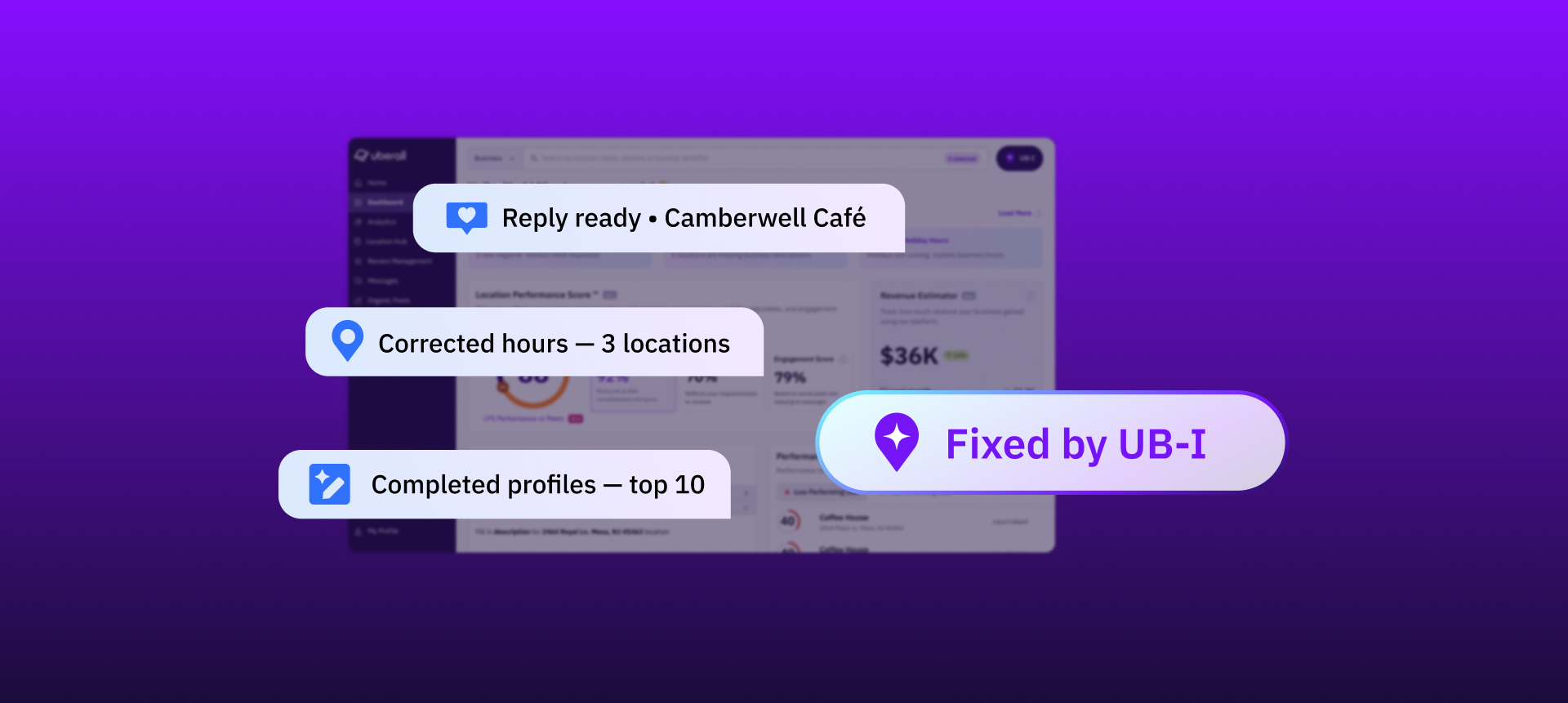
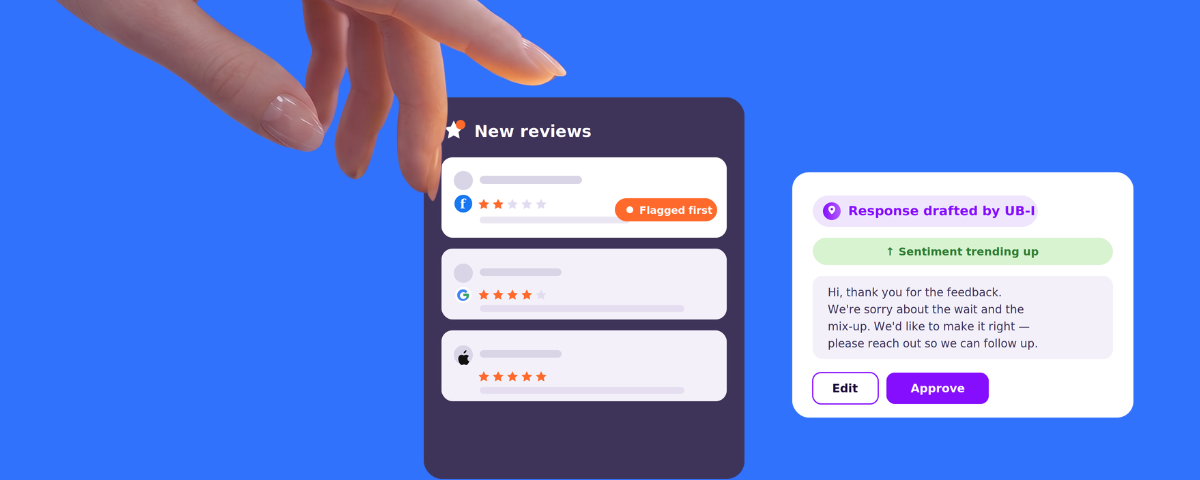
- Review replies (reputation): UB-I drafts AI-generated replies for all pending reviews, prioritizing negative reviews first. The user sees the review and the proposed reply side by side — one click to approve, or edit before sending. No more inbox triage across dozens of review sites. No more inconsistent brand voice from location to location.
- Listing cleansing (visibility): UB-I automatically corrects name and address formatting to each directory’s specific requirements — preventing sync failures and suppressed search visibility. Think of the digital experience manager manually updating hours three to four times a week, only to have Google overwrite them. UB-I monitors, corrects, and keeps listings accurate across every directory — continuously, not in monthly audits.
- Profile completeness (visibility + engagement): Missing descriptions, attributes, and special hours are generated from existing location data and queued for approval. UB-I fills the gaps that lower your Location Performance Score — the profiles that are 70% complete but never get the last push because someone would have to do it manually for every location.
In every case, UB-I acts, and a human approves.
Without the agent, you’ve got a tidy stack and a team that still has to do everything manually. Without the consolidation, you’ve got an agent publishing the wrong hours to every directory at once.
The Guardrails That Make This Agentic Autonomy Safe
Letting a tool act on your behalf at scale raises the cost of every mistake. We know this, which is why we’ve built guardrails and client trust into UB-I as a product feature, not just a value proposition we promise our clients.
After all, if users don’t trust our AI agent, they won’t use the platform. They’ll go back to doing things manually — or worse, they stop making changes altogether because they’re scared of breaking something. I know because this has been my experience with software too. I’ve been paying for tools that just sit there until I end up cancelling them.
Every prospect we talk to asks some version of the same question before they’ll trust our in-platform AI.
One UK retail brand saw Uberall’s AI-generated review replies for the first time in a demo and immediately asked: “Does it pull from pre-saved templates, or does it write something bespoke per review?” When they heard every reply is tailored to the individual review, but still goes through human approval before it’s published, you could almost hear them exhale with relief (almost).
Most brands – especially with hundreds or thousands of locations — want automation, but not many want full end-to-end automation. I don’t blame them; I also want my marketing team to feel in control and at ease over what goes out.
Our AI Product Manager, Murilo, has been part of the team polishing these guardrails continuously: “AI is becoming more common in professional workflows, but not everyone is ready to trust AI output without verification. That’s why UB-I always highlights what changes were made, which locations are affected, and asks for confirmation — so users are always in control.”
UB-I’s approval guardrails and transparency features are built in from the start:
- Approval workflows: UB-I proposes a fix or optimization and queues it for review before a human signs off on it. With reviews: You see the review and the reply. With listings: You see the listing and the correction, side by side.
- Explainability: You can see exactly what UB-I changed, which locations were affected, and why it prioritized that action — no mysteries.
- Audit trail: Every action is logged and attributable, so you have a full record of what happened, when, and who approved it.
- Permissions gating: Your team controls what UB-I can act on and who can approve certain actions.
Exit Manual Mode; Enter Accountable Automation with UB-I
Remember the digital experience manager updating bakery hours three to four times a week really just needed one platform to automate tasks with AI for her — reliably and at scale — while keeping her in the loop in a way that she wasn’t babysitting it.
Buying layers and layers of software to patch up an operational inefficiency in your marketing team makes your data worse, which makes it harder to implement an AI agent that can reliably and accurately execute tasks. It would be like onboarding a new team member without giving them an organized set of approved instructions they need to carry out their job — and you know that will lead to mistakes down the line.
UB-I brings your location data together inside one platform, consolidating into a single source of truth. UB-I orchestrates across it — prioritizing by business impact, drafting the work, and queuing it for your team’s approval.
If your team is still in manual mode — clicking through hundreds of listings, copying review replies from a spreadsheet, updating hours that Google might overwrite by tomorrow — that’s why we built UB-I.



1,800 brands trust us to stay visible
— not just show up once or twice in local search.




.png)
