Nobody Gets Excited About Local Citations … Until They Realize AI Tools Cite Them More Than Your Website
Local citations are online mentions of your business's name, address, and phone number. AI search models now cross-reference them before deciding whether to recommend you.

Key takeaways
- A local citation is any online mention of a business’s name, address, and phone number — on directories, review platforms, social profiles, or niche industry sites
- AI search models and search engines cross-reference citations across dozens of sources to verify businesses before generating a recommendation
- Managing citations manually often leads to citation errors that can trigger Google suspensions and cause AI models to omit affected businesses from their recommendations
“Social mentions are kind of like the new reviews, and it does hold a lot of weight.”

Every directory listing, every review platform profile, every social media page with your business address on it — these are all local business citations. They’re mentions of your business’s name, address, and phone number.
And when businesses have tens or hundreds of locations, those local citations could be in their hundreds or thousands.
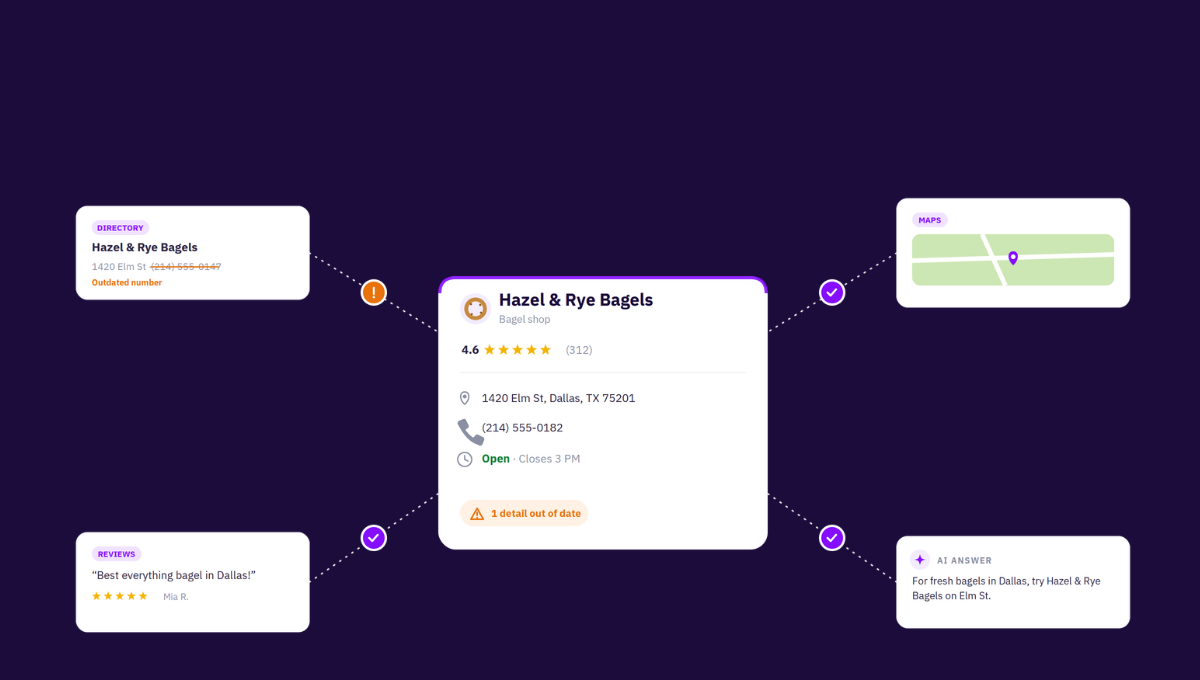
The same issue comes up again and again when we talk to prospects and encourage them to pull up their directory presence with us. They find inconsistencies they didn’t know about. That includes business updates that weren’t published to Apple, hours that are wrong on Yelp, an outdated location page URL that actually sends customers to a 404 page. I stumbled on this last issue just a week ago.
These inconsistencies are an issue — they lead to poor customer experiences with your brand, and Google also cross-references NAP data across directories to decide whether you belong in the Local Pack. AI tools like ChatGPT, Gemini, and Perplexity do the same thing before confidently recommending businesses.
This is the citations breakdown we wish we could send every multi-location marketing team — maybe not in hope that they’ll get excited about local citations (like us), but so that they at least get excited about being able to show up when their customers search for business recommendations in traditional search and AI tools.
What Are Local Citations (A Real Quick Summary)?
The most discoverable business locations have structured and unstructured local citations.
Let’s take a multi-location bagel brand, for example, with a location in Dallas, Texas. If everything is set up well, it has:
- structured citations – the local citations created deliberately, such as a Google Business Profile, Yelp listing, Facebook business page, entry on a cafe or coffee or local lunch spot directory. These are formal business profiles where NAP (name, address, phone number) data sits in dedicated fields alongside opening hours, photos, descriptions, and categories.
- unstructured citations — that is, mentions of the bagel location that appear in foodie blog posts, local news articles, Reddit threads, social media posts, or any other online content where someone references that bagel business by name and location — without it being a formal directory entry.
Both unstructured and structured local business citations send signals to search engines and AI systems. Structured citations tell Google and other platforms “this business exists at this address and offers these services.” Unstructured citations add context on top of that — they tell search engines and AI systems that real people are talking about this business IRL.
Note: A Yelp citation for this bagel brand is not the same as a backlink. Most directory citations are nofollow links, so they don’t pass link equity the way a backlink from a third-party site would. They do different jobs: Citations validate the bagel business’s existence and consistency, while backlinks signal its local authority.
Why Local Search Citations Matter More Now Than They Used To
AI models don’t have their own database of businesses, meaning you can’t submit business data to AI tools like you do with Yelp, Bing or Google. These models, whether ChatGPT, Gemini, or Perplexity, tend to cross-reference information from either their training data or from across the web before deciding whether to recommend you. And directories are a primary source.
While every model retrieves and recommends local businesses differently, they use your local citations as a validation layer to reduce the likelihood of their recommendations leading to a poor experience.
Imagine you’re looking for a good bagel place in downtown Dallas with a lunchtime deal. ChatGPT recommends one for you to try in your lunch break, and you turn up to find the location moved across to another block on the other side of the city. Hangriness ensues, and the business loses credibility, but so does ChatGPT.
So, in practice, any brand with a strong Google Business Profile but no presence on Apple Maps, Yelp, Facebook, or any industry-specific directories will struggle to win AI visibility.
How Every AI Model Recommends Businesses Differently
Our recent in-house experiments at Uberall tell us each model has its own recommendation “personality.”
- Claude is the most conservative — it favors local and community businesses but largely avoids naming specific healthcare providers, likely reflecting caution around anything resembling medical guidance.
- Gemini is the most diverse, likely because it cross-references live Google Maps data. It surfaces 8× more unique restaurants than ChatGPT in the same study.
- ChatGPT is consensus-driven and concentrated — a short, sticky shortlist, but with the highest hallucination rates across verticals.
- Grok references chef qualifications and Instagram content more than any other model, and its responses read like long-form food journalism: “must-try dishes,” chef names, cooking methods, and historical context.
- Perplexity searches live, cites its sources, and generates the most mentions per run. For businesses with strong current web presence, it’s the “easiest” model to win on.
Social Mentions Are the New Unstructured Citations
Claudia Tomina, a Platinum Google Product Expert and founder of Reputation Arm, explained on a podcast episode:
{{quote}}
She shared an example in the episode of a social media profile dedicated to reviewing halal restaurants — not a website, not a blog, just a social media feed. But because search engines and AI systems recognize it as a trusted authority in that specific niche, a mention from that account can directly influence whether AI recommends the restaurants it covers.
That’s why multi-location businesses should really look at micro-influencers, local bloggers, and even active community members on social platforms as part of their long-term citation strategy.
For multi-location brands, it’s definitely not just about submitting NAP data to 30 directories anymore. It’s about third parties verifying the experience you promise on-site — whether that’s halal dishes, outdoor seating, large event spaces. That kind of information shouldn’t just live in a Google Business Profile description.
Up-to-Date Local Citations Aren’t Exciting — But You’re Not Discoverable Without Them
Nothing flagged that 404 I mentioned at the top, sending local customers to a dead end. I found it completely by chance, and I assume that any customer landing on that GBP ended up visiting a competitor’s website.
An incorrect URL is just one data point an AI model checks before deciding whether to recommend you, and any mismatch is a reason to mention or cite a nearby competitor.
So here’s the ask: If you’re running more than a handful of locations and you can’t remember the last time you looked at your citations, go look — that’s definitely the place to start.
Make sure you find the broken link or the outdated address before a customer or ChatGPT does.


1,800 brands trust us to stay visible
— not just show up once or twice in local search.


.png)

Frequently asked questions
A local citation is an online mention of a business’s name, address, and phone number — it validates that the business exists at a stated location. A backlink is a clickable link from another website that passes ranking authority to yours. Most directory citations are nofollow, so they don’t transfer link equity the way backlinks do. They serve different purposes: Citations confirm legitimacy and location, while backlinks signal authority to search engines.
The best local citation websites for multi-location businesses start with Google Business Profile, Apple Maps, Yelp, Facebook, and Bing Places. These carry the most authority and traffic. From there, add industry-specific directories relevant to your vertical, like TripAdvisor for hospitality or Zocdoc for healthcare. Niche directories strengthen relevance signals for both search engines and AI models. Uberall publishes to 150+ directories across search, maps, social, and navigation platforms.
There is no fixed number of local citations a business needs. Consistency matters more than volume. Research suggests businesses with accurate data across 40 or more authoritative directories see measurably higher local search visibility, but 20 consistent citations outperform 100 inconsistent ones. Start with major platforms like Google Business Profile, Apple Maps, Yelp, and Facebook, then expand to industry-relevant directories where your customers search.
Inconsistent local citations — where your name, address, or phone number varies across directories — hurt trust with both search engines and AI models. Google cross-references NAP data across sources, and mismatches can suppress your Local Pack rankings. AI tools like ChatGPT and Perplexity do the same before recommending businesses. In severe cases, conflicting NAP data can contribute to a Google Business Profile suspension. Customers who encounter outdated details are also more likely to visit a competitor.
AI models use local citations as a validation layer before recommending a business. Tools like ChatGPT, Gemini, and Perplexity don’t maintain their own business databases — they cross-reference information from directories, review sites, and web sources to confirm a business is real and located where it claims. If your NAP data conflicts across sources, these models are less likely to recommend you. Uberall’s in-house research found each model has distinct recommendation behaviors.
Social media mentions do count as local citations — they function as unstructured citations that tell search engines and AI systems real people are talking about your business. A mention on a local food review account or a community Facebook group carries weight because these platforms can hold niche authority. Multi-location brands should consider local influencers and community voices as part of their long-term citation strategy.
Local citations are not the same as directory listings — directory listings are one type of citation, but not the only type. Citations fall into two categories: structured citations, which are formal listings on platforms like Google Business Profile, Yelp, or Apple Maps, and unstructured citations, which are informal mentions in blog posts, news articles, Reddit threads, or social media. Both types send signals to search engines and AI models that your business is real and active.
Inconsistent citations can contribute to a Google Business Profile suspension. Google’s systems cross-reference your profile data against your website, directories, and public records. When your name, address, or phone number doesn’t match across these sources, it can flag your listing for review — particularly when combined with other trust signals like large profile edits or duplicate listings. Cleaning up NAP inconsistencies across all directory listings is a standard step in any suspension recovery process.